
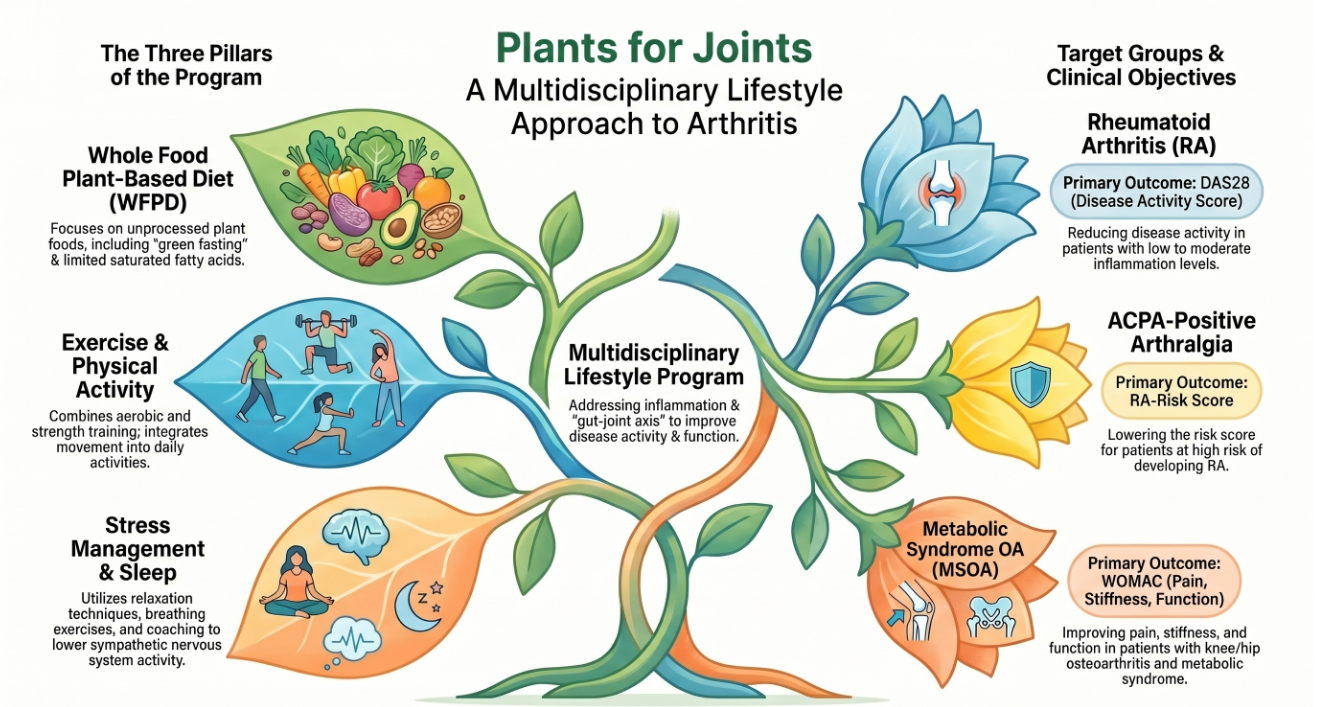
We've been conditioned to view Rheumatoid Arthritis (RA) as an inescapable mutiny of the immune system and Osteoarthritis (OA) as the inevitable "rusting" of our mechanical parts. But a radical departure from that "bone-on-bone" imagery is emerging from the Plants for Joints multidisciplinary program. This isn't just another diet; it is a clinical manifesto suggesting that the "silent fire" of low-grade systemic inflammation is the hidden thread connecting disparate joint pathologies. By shifting the focus from symptom management to a holistic biological reset, we are beginning to see that joints are profoundly influenced by how we eat, move, and think.
01
The Gut–Joint Axis: Why Your Immune System Learns Pain in the Microbiome
It is a profound irony of modern medicine that the origin of your hand or knee pain may actually lie in your digestive tract. This "mucosal origin" of RA suggests that the gut is the primary classroom where the immune system learns the difference between "self" and "foe." When the microbiome falls into dysbiosis — an imbalance where opportunistic bacteria like Lactobacillus salivarius and Prevotella copri over-proliferate — the body loses its immune tolerance.
This imbalance does more than just irritate the gut; it hijacks the autonomic nervous system. In RA patients, the "fight or flight" sympathetic nervous system often takes the wheel, leading to lower heart rate variability (HRV) and a body that remains in a state of high alert.
"In RA, a chronic autoimmune arthritis condition, the presence of low-grade inflammation — possibly intermediated by microbiome dysbiosis — may cause the breakdown of immune tolerance."
When the gut's barrier is compromised, autoantibodies are produced at mucosal sites long before the first joint swells. Treating the joint without addressing the microbiome is like trying to put out a house fire while someone is still pouring gasoline in the basement.
02
MSOA: Osteoarthritis as a Metabolic Malfunction
We must stop dismissing Osteoarthritis — specifically in the weight-bearing joints of the knee and hip — as simple "wear and tear." Emerging science identifies a distinct phenotype: Metabolic Syndrome-Associated Osteoarthritis (MSOA).
In this model, the joint isn't just wearing out; it is being chemically degraded by a systemic profile of high blood pressure, elevated cholesterol, and high fasting glucose. Central to this is visceral fat — the weight around the midsection. Far from being dormant storage, visceral fat acts as an active endocrine organ, pumping out a relentless stream of inflammatory chemical messengers that irritate your joints from the inside. This explains why OA patients so frequently suffer from comorbidities like diabetes and cardiovascular disease; the "fire" in the knee is the same fire threatening the heart.
03
The 1+1+1=5 Effect: The Power of Multidisciplinary Synergy
The Plants for Joints program utilizes three pillars: a Whole Food Plant-Based Diet (WFPD), specific exercise, and stress management. However, the true magic lies in the synergy — the "1+1+1=5" effect where the combined impact far exceeds the sum of isolated interventions.
The program pairs a fiber-rich WFPD (including a targeted "green fasting" protocol) with exercise that mirrors the Dutch Exercise Guideline, combining aerobic activity with muscle strength training. But the secret weapon is mindfulness. The data reveals that patients with higher mindfulness scores actually respond more robustly to physical exercise.
The mechanism is elegant: while stress and systemic inflammation fuel the sympathetic "fire," the combination of plant-based phytonutrients, movement, and meditation activates the parasympathetic "rest and digest" system. This neurological shift acts as a biological coolant, dampening the inflammatory response and allowing the body to begin the work of repair.
04
Tapering the Pill Load: Achieving Clinical Mastery
While pharmaceutical intervention is the current paradigm, it remains a flawed one for the 30% of patients who either don't respond to medication, suffer from debilitating side effects, or develop resistance. The Plants for Joints approach offers a path toward "medication tapering" — a goal once thought impossible for many chronic sufferers.
The protocol establishes a clear clinical target: for RA patients who achieve a Disease Activity Score (DAS28) of less than 2.6 (the threshold for minimal disease activity), a standardized tapering scheme is introduced. This isn't just about reducing a pill count; it's about a fundamental shift in agency. It empowers the patient to move from a passive recipient of pharmaceuticals to an active master of their own biological terrain.
05
Adherence: The Only Medicine That Works Long-Term
Lifestyle medicine is often criticized as being "too hard" to stick to, but the Plants for Joints protocol treats behavior change with the same rigor as a drug trial. Researchers utilize a sophisticated Lifestyle index adherence score to track progress over a 2-year extension study.
This isn't your grandmother's low-fat diet. Moving beyond the 1990s-era Ornish models that focused solely on reducing total fat, this modern index prioritizes fiber intake and the reduction of saturated fatty acids (SFAs) as the primary indicators of success. By focusing on the molecular quality of the fuel — specifically how fiber feeds the microbiome — the program ensures that the behavioral shifts are rooted in modern nutritional science rather than deprivation. The real medicine isn't the 16-week program; it's the participant's ability to weave these habits into the permanent fabric of their lives.
06
A New Paradigm for Chronic Care
The Plants for Joints mission represents a hopeful frontier in rheumatology. It acknowledges that while we cannot change our genetics, we can absolutely change the environment in which our genes express themselves. We are moving away from a world of managing chronic "smoke" and toward a future where we address the "fire" at its source.
As we look toward this new era of joint health, a provocative question remains for each of us: Are you merely managing the symptoms of your discomfort, or are you ready to engage your internal "firefighters" — your diet, your movement, and your mind — to extinguish the source? The future of your mobility may depend not on what is in your medicine cabinet, but on what is on your plate and in your heart.
Reference
Study protocol
Walrabenstein W, van der Leeden M, Weijs P, van Middendorp H, Wagenaar C, van Dongen JM, Nieuwdorp M, de Jonge CS, van Boheemen L, van Schaardenburg D. The effect of a multidisciplinary lifestyle program for patients with rheumatoid arthritis, an increased risk for rheumatoid arthritis or with metabolic syndrome-associated osteoarthritis: the "Plants for Joints" randomized controlled trial protocol. Study Protocol, Open Access.