
01
The clock is ticking: eight fractures every minute
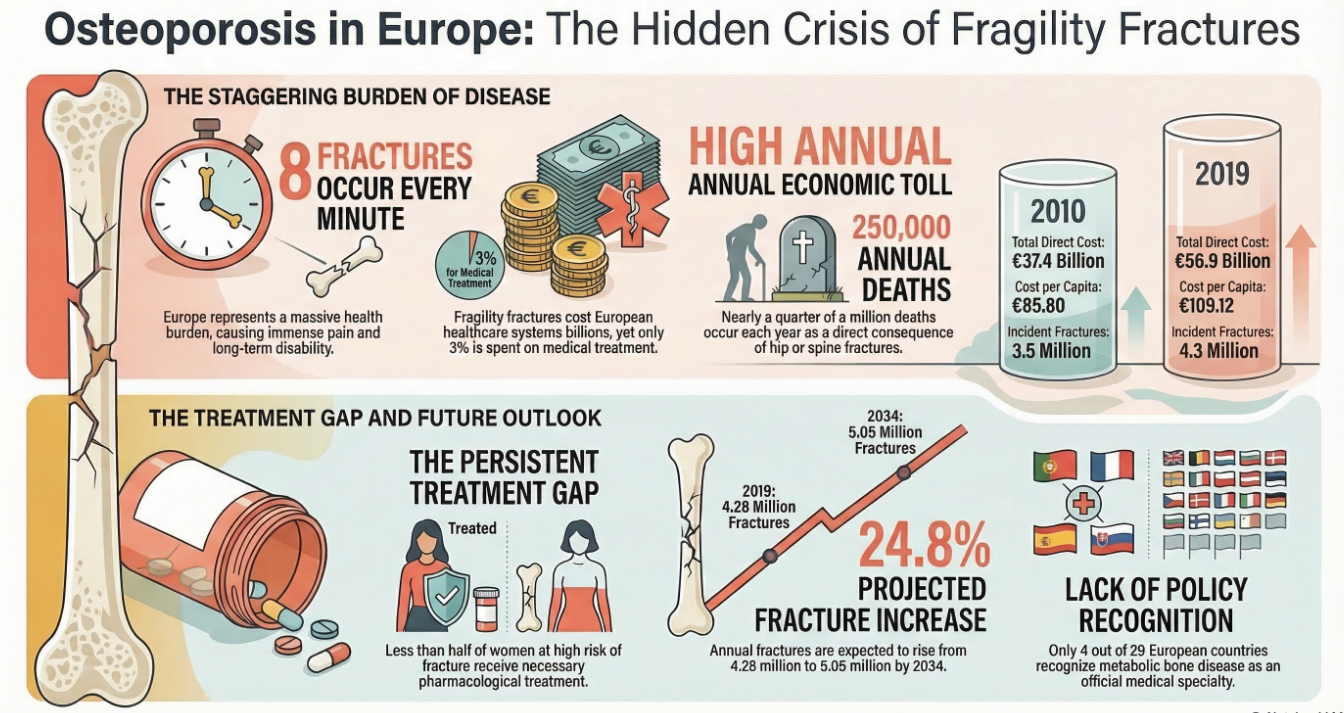
Every sixty seconds, eight people in Europe experience a fragility fracture. This steady rhythm reflects a major public health challenge that often remains hidden until a fracture occurs.
Osteoporosis is a complex, chronic condition in which bone mass and bone microarchitecture are reduced. This can make bones more fragile, so that a minor fall or everyday incident may lead to a serious fracture.
To evaluate how Europe is responding, the International Osteoporosis Foundation released the SCOPE 2021 scorecard, an analysis of osteoporosis management across the 27 EU member states plus the United Kingdom and Switzerland.
Despite decades of medical progress, the report highlights major differences across countries in diagnosis, treatment access and healthcare investment.
02
The 3% paradox: high costs, limited spending on medical treatment
Fragility fractures cost European healthcare systems more than €56.9 billion annually, based on 2019 data. Yet only 3% of that total was spent on medical treatment or pharmacological intervention, compared with 5% in 2010.
Direct costs increased by 64% over nine years, while spending on pharmacological care did not keep pace.
The report suggests that many systems remain largely reactive. When early diagnosis and treatment pathways are underused, healthcare systems may face much higher downstream costs from hospitalisation, surgery and long-term care.
According to the SCOPE data, one in three women and at least one in six men will experience an osteoporotic fracture during their lifetime. More than 23 million people in Europe are estimated to be at high risk.
03
Why fragility fractures should be taken seriously
A fracture is sometimes dismissed as simply a broken bone, but the data show a more serious picture.
In 2019, the EU27+2 recorded 4,275,547 incident fractures. Each year, around 250,000 deaths occur after hip or spine fractures, with approximately 30% considered causally related to the fracture event itself.
In Sweden, fragility fractures cause more deaths than road traffic accidents and nearly as many as breast cancer. Up to 20% of hip fracture patients die within the first year, and fewer than half of survivors regain their previous level of independence.
04
A postcode lottery for bone health
The SCOPE report describes marked differences across European countries, creating a postcode lottery in osteoporosis care and bone health outcomes.
Estimated costs per person vary widely:
- Switzerland: €403 per person
- Denmark: €251 per person
- Romania: €13 per person
Since 2010, cost per capita has risen in every surveyed country except the United Kingdom and Estonia. Access to diagnosis and treatment is often shaped by national systems and geography, not only by clinical risk.
05
The invisible 23 million: Europe's treatment gap
Despite the availability of effective and affordable medications, 23 million people in Europe are estimated to live at high risk of fractures.
Even after a first fracture, which can be an important warning sign, only a minority of people receive treatment in many countries.
The SCOPE report notes that less than half of women at high risk of fracture are treated, despite the high cost of fractures and the availability of affordable medications.
06
The demographic clock: the road to 2034
Between 2019 and 2034, the population aged 75 and older is projected to grow by 29.6% among women and 42.6% among men.
Annual fragility fractures in the EU27+2 are expected to increase by 1.06 million, representing a 24.8% rise over fifteen years.
These projections show why bone health, medical assessment and coordinated care pathways are increasingly relevant for Europe's ageing population.
07
A call for coordinated action
The diagnostic tools and affordable medications needed to reduce the treatment gap already exist. However, many healthcare systems continue to carry high costs from surgery, hospitalisation and long-term care after fractures occur.
In the fifteen minutes it may take to read this analysis, around 120 people in Europe will have experienced a fragility fracture.
Knowing your family history, speaking with healthcare professionals about personal risk, and building daily habits around bone health — including balanced nutrition, appropriate weight-bearing movement, sleep and safe sunlight exposure — can be part of a broader healthy ageing approach.
Source: SCOPE 2021: a new scorecard for osteoporosis in Europe — Kanis JA, Norton N, Harvey NC, Jacobson T, Johansson H, Lorentzon M, McCloskey EV, Willers C, Borgström F.